
Why Test Your Water in Fauquier County (and What It Means for Your Appliances)
· By Fauquier DIY
If you live out in the county, your water probably comes from a well in your own yard, and nobody tests it for you. Here's what the research says, what your water can do to your appliances, and a few simple fixes.
Lots of us are on our own water
- Fauquier County says 84% of residents rely on groundwater, and residents outside the Town of Warrenton rely only on groundwater [1].
- USGS estimated that in 2015 about 31,300 of Fauquier's roughly 68,800 residents (about 45%) supplied their own household water, which mostly means private wells [2].
- "VDH does not test private wells." After a new well's bacteria test, testing is up to the owner [3]. EPA says private well owners are responsible for safe water [4].
What shows up in Fauquier wells
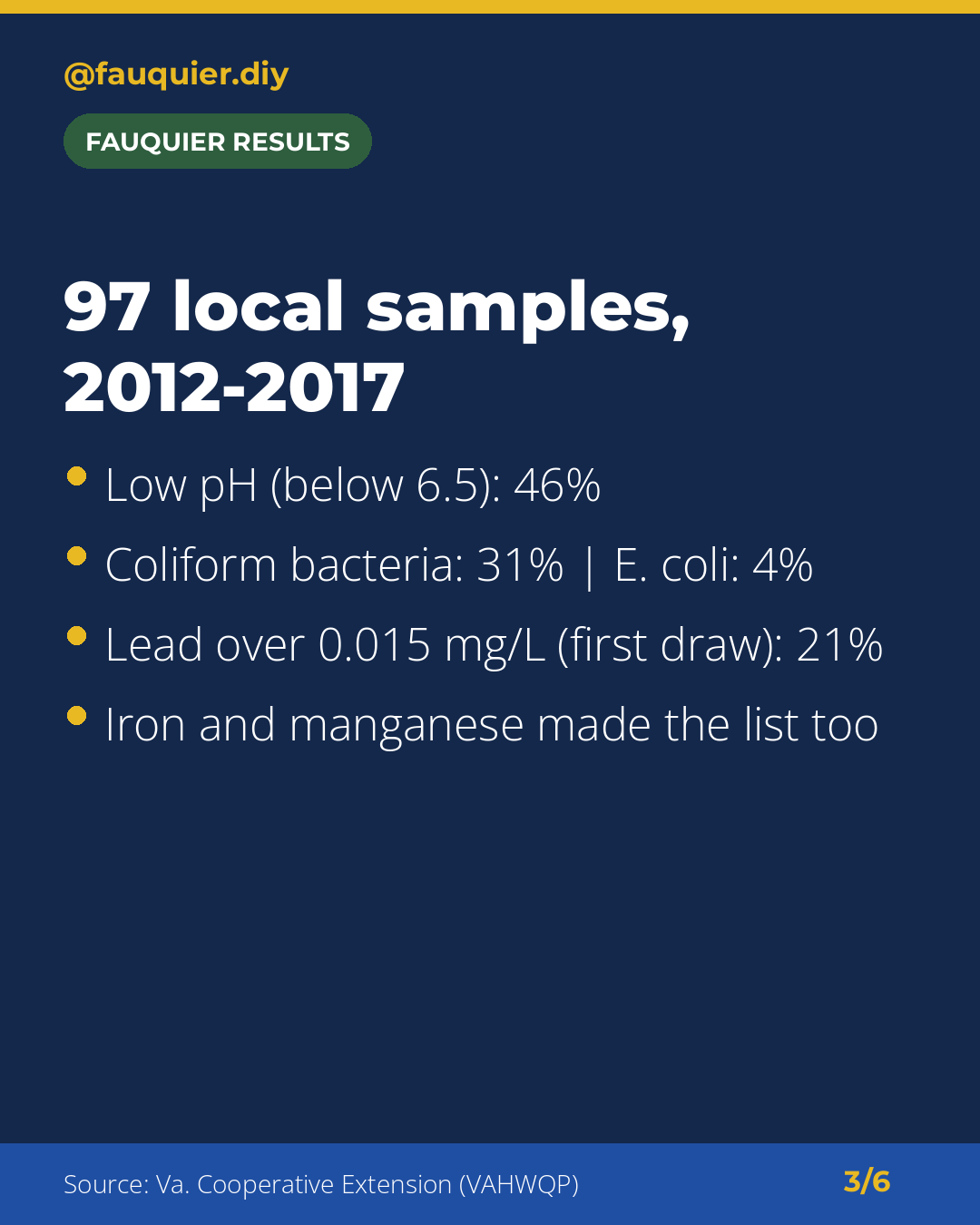
Virginia Cooperative Extension tested 97 Fauquier samples from 2012 to 2017 [5]. These were volunteers, not a random survey:
- Low pH (below 6.5) in 46%. Low pH water is more corrosive and can pull copper and lead out of plumbing [5].
- Total coliform bacteria in 31%, E. coli in 4% [5].
- Lead above 0.015 mg/L in 21% of first-draw samples; copper above 1 mg/L in 12% [5].
- Manganese and iron also made the most-common list [5].
Statewide Virginia Tech studies agree: 41% of 538 wells and springs had total coliform and 10% had E. coli [6], and almost 20% of 2,146 first-draw samples topped EPA's lead action level [7].
On public water? FCWSA reported no E. coli and no violations in 2025, and it lists iron and manganese as issues in its Green Meadows, Marshall and New Baltimore systems [8]. Look up your system's report at fcwsa.org [8].
What hard water, iron and sediment do to appliances
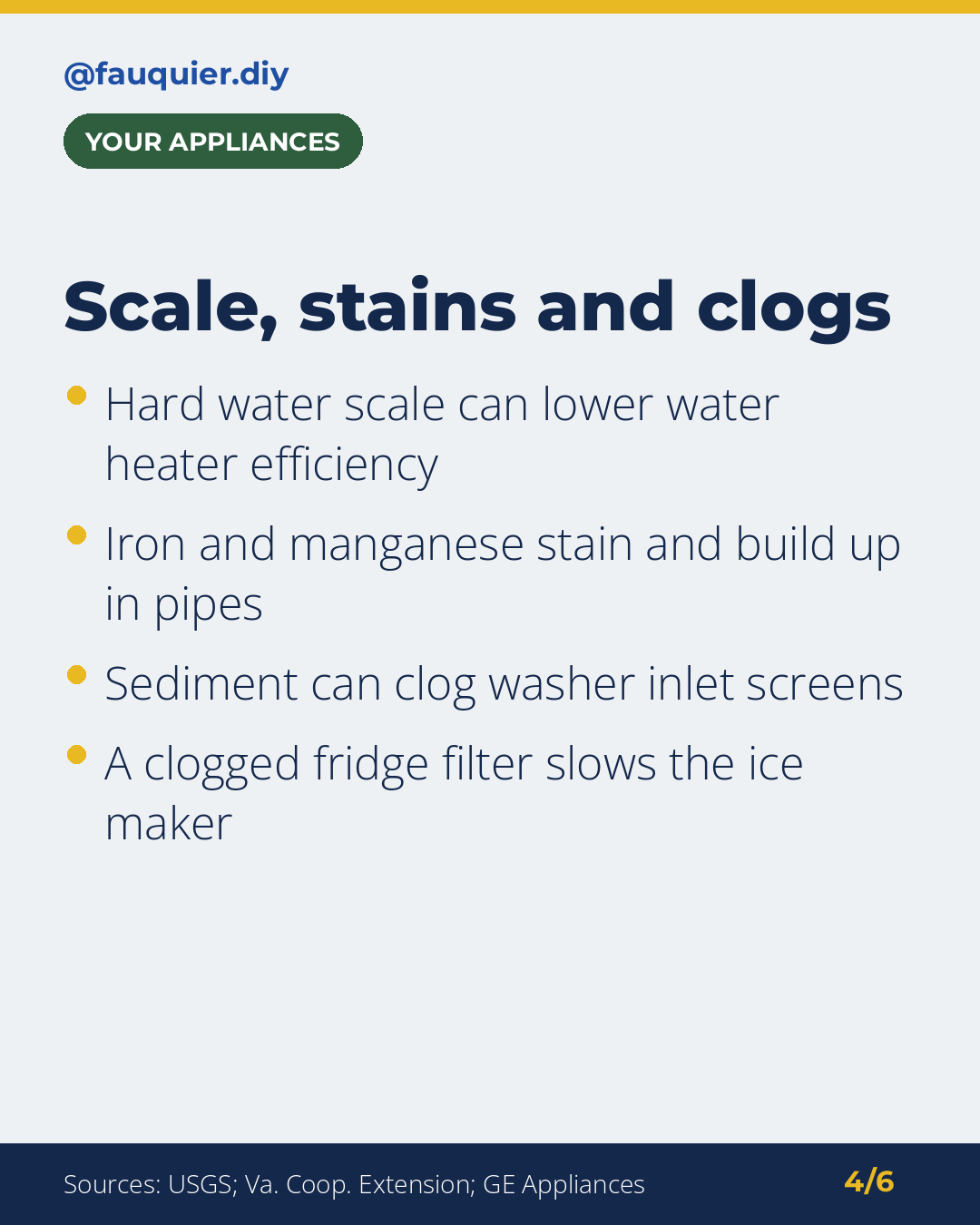
Hardness (calcium and magnesium) leaves scale when heated. USGS says scale can shorten equipment life, raise water-heating costs and clog pipes [9]. Extension says it can lower water heater efficiency [10]. Iron and manganese stain laundry and dishes and build up in pipes, water heaters and softeners, lowering pressure and raising appliance operating costs [11].
A lab study: Battelle ran appliances on softened water and very hard water (26 grains per gallon), sped up to mimic years of use [12]. Gas tank water heaters on hard water fell from 70.4% to 67.4% efficiency over two equivalent years; tankless units fell from 80% to 72% and needed deliming. Hard-water dishwashers and washers had scale on all inside surfaces after 240 cycles; soft-water units were nearly scale-free [12]. Note: this study was funded by the Water Quality Research Foundation, a nonprofit aligned with the Water Quality Association, the water-treatment industry's trade group [12][13]. Its water was harder than many homes have, so read it as a worst case.
What the manufacturers say:
- Dishwashers: Bosch's manual says hard water leaves limescale and can block parts, and you set your water hardness on the dishwasher [14]. Rinse aid helps prevent spots in hard water [15].
- Fridges and ice makers: GE recommends a new filter every six months, or sooner if water or ice flow slows [16]. A clogged filter restricts water to the ice maker [17].
- Washers: inlet screens catch sediment and can be cleaned [18]. Whirlpool says clean the washer monthly, more often with hard water [19].
- Water heaters: Rheem says flush yearly, or every six months with hard water; descale tankless units [20]. EPA WaterSense also recommends a yearly flush [21].
Simple steps
- Test your water. VDH recommends bacteria and nitrate every year, plus a basic test covering hardness, iron, manganese, pH and lead [3].
- Set your dishwasher's hardness from your results and keep rinse aid filled [14][15].
- Change the fridge filter on schedule [16].
- Clean washer inlet screens and flush the water heater [18][20].
- Consider treatment if results call for it. Extension says hardness under 7 grains per gallon usually doesn't need treatment unless it's causing problems [10]. Match treatment to your results [3].
Safety note
Treatment installs or plumbing changes may need a licensed plumber. Rheem suggests a pro for older heaters or gas and electrical work [20].
FAQ
How often should I test? Bacteria and nitrate yearly; a basic test every 5 years if all is well [3].
Does the state test my well? No [3].
Is hard water unsafe? Extension says it isn't a health risk, just a scale and cleaning problem [10].
I'm on FCWSA water. Should I test? FCWSA tests its systems [8], but lead can come from your home's plumbing, so contact FCWSA if you're concerned [8].
Buying a new appliance or moving into a home on a well?
Reach out for appliance advice. My opinion: know your water before you pick a dishwasher, fridge or water heater.
- Phone: (540) 316-0813
- Email: fauquier.diy@gmail.com
- Web: fauquierdiy.com
Sources
All links checked Oct 17, 2026.
- Fauquier County, VA. "Water Resources." Fauquier County Government, n.d.
- U.S. Geological Survey (Dieter, C.A., et al.). "Estimated Use of Water in the United States County-Level Data for 2015," v2.0, 2018 (Fauquier County row: total population 68.782 thousand; self-supplied domestic population 31.328 thousand).
- Virginia Department of Health. "Private Well Program."
- U.S. EPA. "Private Drinking Water Wells." Also: "Protect Your Home's Water"
- Virginia Cooperative Extension / Virginia Household Water Quality Program. "Household Water Quality: Fauquier County 2012-2017," 2017.
- Allevi, R.P., Krometis, L.A., Hagedorn, C., Benham, B., Lawrence, A.H., Ling, E.J., Ziegler, P.E. "Quantitative analysis of microbial contamination in private drinking water supply systems." Journal of Water and Health 11(2):244-255, 2013.
- Pieper, K.J., Krometis, L.A., Gallagher, D.L., Benham, B.L., Edwards, M. "Incidence of waterborne lead in private drinking water systems in Virginia." Journal of Water and Health 13(3):897-908, 2015.
- Fauquier County Water and Sanitation Authority. "Annual Water Quality Report 2025" (2026 CCR for calendar year 2025). Also: report index
- U.S. Geological Survey, Water Science School. "Hardness of Water."
- Ling, E.J. "Virginia Household Water Quality Program: Hardness in Household Water," VCE Publication 442-664, Virginia Cooperative Extension, 2024.
- Ling, E.J., et al. "Virginia Household Water Quality Program: Iron and Manganese in Household Water," VCE Publication 442-656, Virginia Cooperative Extension, 2025.
- Battelle Memorial Institute, for the Water Quality Research Foundation. "Softened Water Benefits Study: Benefits of Removal of Water Hardness From a Water Supply," executive summary, 2009 (industry-funded; water heaters supplied by WQA).
- Water Quality Association. "About WQA."
- Bosch. "Use and Care Manual, SHP65CC5UC dishwasher," sections 9 (Water softening system) and 10 (Rinse aid).
- Bosch Home Appliances (US). "Why fill your dishwasher's rinse aid dispenser."
- GE Appliances. "Side-by-Side Refrigerator - How to Change the Water Filter."
- GE Appliances. "Refrigerator - Slow Ice Production."
- GE Appliances. "Washer - Screens in Hot & Cold Water Inlets / Connections."
- Whirlpool. "Cleaning Washers with affresh®," Product Help.
- Rheem. "How Often To Flush Your Water Heater (And How To Do It)," May 29, 2026.
- U.S. EPA WaterSense. "Home Maintenance."
- Virginia Household Water Quality Program. "2026 Drinking Water Clinics."
- Virginia Cooperative Extension, Fauquier County. "Virginia Household Water Quality Program."
- Ling, E., Snyder, M. "Virginia Household Water Quality Program" interpretation meeting slides, 2026.
Source pages are linked as I read them. Pages change, so check the original for the latest.
Get the Fauquier DIY newsletter
Maintenance reminders and plain-words appliance tips for Fauquier County neighbors. No spam.
You can unsubscribe anytime with one click from any email. I will never sell or share your address.
Mailing address: 12025 Leeds Chapel Lane, #186, Hume, VA 22643
Views are my own and not affiliated with any companies or manufacturers mentioned.
Views are my own and not affiliated with any companies or manufacturers mentioned.